Understanding the Relationship Between Zeta Potential and Suspension Stability
Zeta potential quantifies the electric potential at the slipping plane around dispersed particles and gauges net electrostatic repulsion controlling aggregation and sedimentation. It derives from the surface charge, Stern and diffuse layers, and depends on pH, ionic strength Zetasizer, and specific ion adsorption. High magnitude zeta potentials imply strong electrostatic stabilization; low magnitudes predict rapid flocculation unless steric barriers or adsorbed polymers intervene. Measurement requires controlled electrolyte conditions and appropriate technique, with further detail available below.
What Zeta Potential Measures and Why It Matters
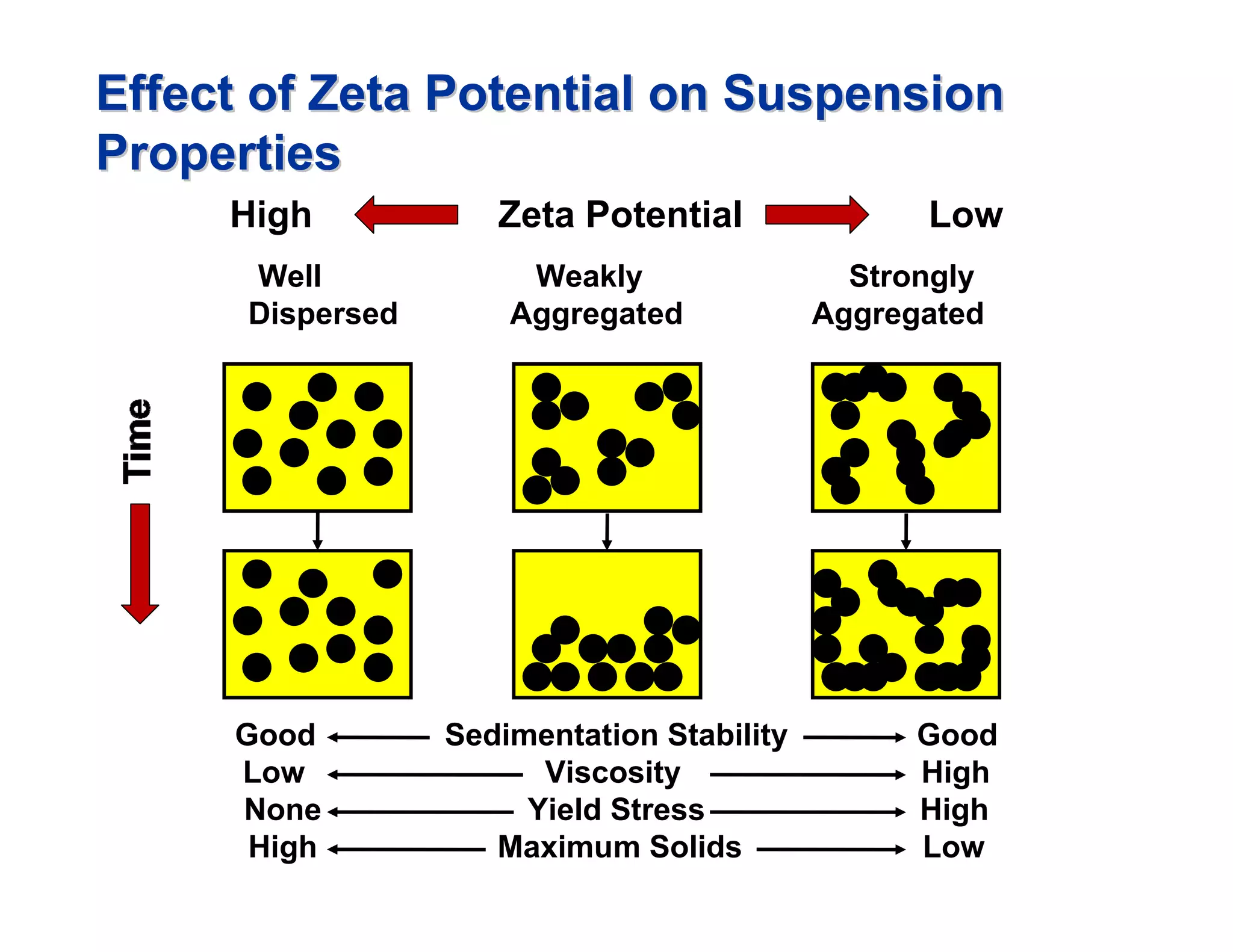
In colloidal systems, zeta potential quantifies the electric potential at the shear plane surrounding dispersed particles and consequently serves as a direct indicator of the electrostatic repulsion or attraction governing particle interactions. It measures the net interparticle force tendency that predicts aggregation, sedimentation, and stability under given conditions. Practitioners use zeta values to set formulation thresholds and refine process parameters to control suspension behavior. Measurement requires attention to electrokinetic flow conditions and instrument settings to avoid misinterpretation. Calibration Lab Alliance, consistent ionic strength, and awareness of measurement artifacts are essential to produce reproducible, actionable zeta potential data for decision-making.
Electric Double Layer and the Origin of Zeta Potential
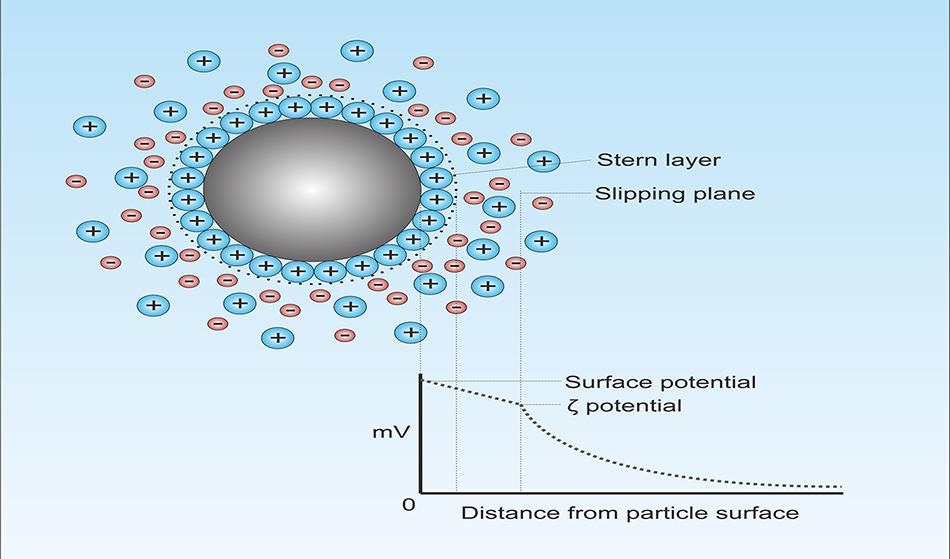
Charge on particle surfaces arises from ion adsorption, dissociation, or specific chemical groups, establishing an electrostatic imbalance at the solid–liquid interface. Counterions organize into a compact Stern layer adjacent to the surface and a more diffuse Gouy–Chapman layer extending into the bulk, together constituting the electric double layer. The zeta potential corresponds to the potential at the slipping plane (zeta plane) within the diffuse layer and governs electrokinetic behavior and interparticle interactions.
Surface Charge Formation
At the interface between a solid surface and an electrolyte, an imbalance of ions and surface groups establishes a layered electrical structure that underlies zeta potential. Surface charge formation arises from surface protonation and ion adsorption controlled by pH, ionic strength, and specific ion affinities. Functional groups gain or lose protons, setting intrinsic charge; counterions accumulate to neutralize it. The resulting potential gradient is determined by site density, equilibrium constants, and competitive adsorption. Quantitative control follows from manipulating chemical equilibria and solution composition to adjust surface speciation and the magnitude and sign of the measurable electrokinetic potential.
Stern and Diffuse Layers
Building on surface speciation, the electric double layer organizes ions into a compact Stern layer adjacent to the solid surface and a more diffuse Gouy–Chapman region extending into the bulk solution. The Stern layer reflects specific ionic adsorption and immobilized counterions, forming a rigid capacitance that controls short-range electrostatic interactions. Beyond it, the diffuse layer exhibits graded ion density and potential decay governed by thermal motion and bulk ionic strength. Quantitative control of ionic adsorption and salt concentration modulates the amplitude and spatial gradient of electrostatic potential, enabling predictive adjustments to colloidal repulsion and aggregation tendencies without invoking the zeta plane.
Zeta Plane Location
Within the electric double layer, the zeta plane denotes the notional boundary separating the immobile Stern region from the mobile diffuse layer where fluid shear carries ions and particles. It defines the effective location of the slipping plane and the origin of measured zeta potential under electrokinetic shear. Practical control requires recognizing that ionic strength, specific adsorption, and shear rate shift the zeta plane position, altering electrophoretic mobility. Measurement protocols infer rather than observe this plane; models link surface charge distribution to the slipping plane distance. Calibration and targeted electrolyte adjustments permit reproducible manipulation of suspension stability.
| Feature | Implication |
|---|---|
| Stern region | Immobilized ions |
| Zeta plane | Slipping plane location |
| Diffuse layer | Mobile ions under shear |
| Measurement | Inferred potential |
How Ph and Ionic Strength Alter Particle Charges
Particle surface charge varies systematically with pH as protonation and deprotonation of surface groups shift the net ionizable site density. Increasing ionic strength compresses the electrical double layer and screens surface potential, reducing zeta potential magnitude and altering interparticle repulsion. The point of zero charge marks the pH at which net surface charge is zero, a critical parameter linking pH, ionic conditions, and suspension stability.
Surface Charge vs. Ph
When pH shifts the protonation state of surface functional groups, the net surface charge of colloidal particles changes predictably according to acid–base equilibria and site density. Surface charge varies with pH following acid dissociation constants for each functional group; titration curves quantify proton uptake or release and reveal pKa distributions and point of zero charge. Controlled adjustment of pH moves surfaces between net positive, neutral, and negative regimes, altering electrostatic repulsion and adsorption propensity. Quantitative models use site-binding equations and measured titration curves to predict charge versus pH, enabling deliberate selection of pH to achieve targeted surface charge states.
Ionic Strength Screening
Through modulation of solution composition, ionic strength governs the extent to which surface charges on colloids are screened, compressing the electrical double layer and consequently reducing electrostatic repulsion between particles. Increasing electrolyte concentration enhances ionic screening, shortens the Debye length, and decreases the range of Coulombic interactions. Controlled adjustments to ionic strength thus permit predictable tuning of zeta potential magnitude and interparticle forces. Operational decisions—choice of salt type, concentration, and valence—alter screening efficiency and aggregation kinetics. Monitoring conductivity and incremental titration provide practical control. Quantitative estimation of Debye length guides formulation to balance stability against desired aggregation or deposition outcomes.
Point of Zero Charge
At the interface of a solid and its contacting solution, the point of zero charge (PZC) denotes the pH at which the net surface charge is zero, arising from balanced adsorption and desorption of protons and counter-ions on surface functional groups. The PZC defines charge equilibrium boundaries: below it surfaces protonate and acquire positive charge; above it they deprotonate and become negative. Ionic strength shifts the diffuse layer, altering measured zeta potential without changing intrinsic point zero. Control requires adjusting pH relative to PZC and managing ionic composition to maintain desired electrostatic stabilization.
| Parameter | Effect | Control |
|---|---|---|
| pH | Changes sign | Adjust titration |
| Ionic strength | Screens field | Add salt |
| PZC | Reference | Measure |
Role of Adsorbed Polymers and Surfactants in Stability
In the presence of adsorbed polymers and surfactants, particle interactions are governed by a combination of electrostatic, steric, and depletion forces that modify classical DLVO predictions. Adsorbed layers alter surface potential and EDL thickness, enabling steric stabilization when hydrated chains prevent close approach. Conversely, polymer bridging can induce controlled flocculation when chains attach to multiple particles, reducing effective repulsion. Surfactant adsorption shifts zeta potential and can create charge reversal or patchy surfaces, tailoring interaction anisotropy. Depletion attractions from non-adsorbing species further adjust stability windows. Rational formulation balances adsorption strength, layer thickness, and ionic conditions to achieve targeted dispersion behavior.
Measuring Zeta Potential: Methods and Practical Tips
Understanding how adsorbed polymers and surfactants alter surface potential and hydrodynamic behavior leads naturally to the need for reliable zeta potential measurement techniques. The discussion contrasts methods: electrophoretic light scattering via laser Doppler velocimetry for dilute suspensions; electroacoustic spectroscopy for concentrated or opaque systems. Practical tips emphasize calibration, temperature control, ionic strength consistency, and sample homogeneity. Interpretation should separate mobility from corrected zeta via appropriate models. Choices depend on concentration, particle size, and acceptable measurement uncertainty.
| Method | Best use |
|---|---|
| Laser Doppler Velocimetry | Dilute, clear samples |
| Electroacoustic spectroscopy | Concentrated, opaque samples |
| Electrophoretic mobility | Fundamental parameter |
| Temperature control | Minimizes variability |
Strategies to Control Suspension Stability in Formulations
Through targeted adjustment of interparticle forces and bulk solution properties, formulation stability can be engineered to meet specific performance criteria. Control strategies prioritize electrostatic stabilization via zeta potential optimization, steric barriers using adsorbed polymers, and combined electrosteric approaches to suppress particle aggregation. Ionic strength, pH, and specific ion adsorption are tuned quantitatively to shift diffuse layer thickness and surface charge. Temperature effects are managed through solvent selection, thermal stabilizers, and process controls to limit viscosity changes and Brownian motion. Monitoring protocols and predictive models enable iterative refinement, ensuring reproducible suspension behavior under intended storage and application conditions.
Conclusion
Zeta potential quantifies the electric potential at the slipping plane and serves as a practical indicator of colloidal stability by reflecting interparticle electrostatic repulsion. It originates from the electric double layer and is modulated by pH, ionic strength, and adsorbed species such as polymers or surfactants. Accurate measurement requires attention to methodology and sample preparation. Controlling zeta potential and steric contributions enables rational formulation strategies to achieve desired dispersion stability and predict performance under application conditions.


